
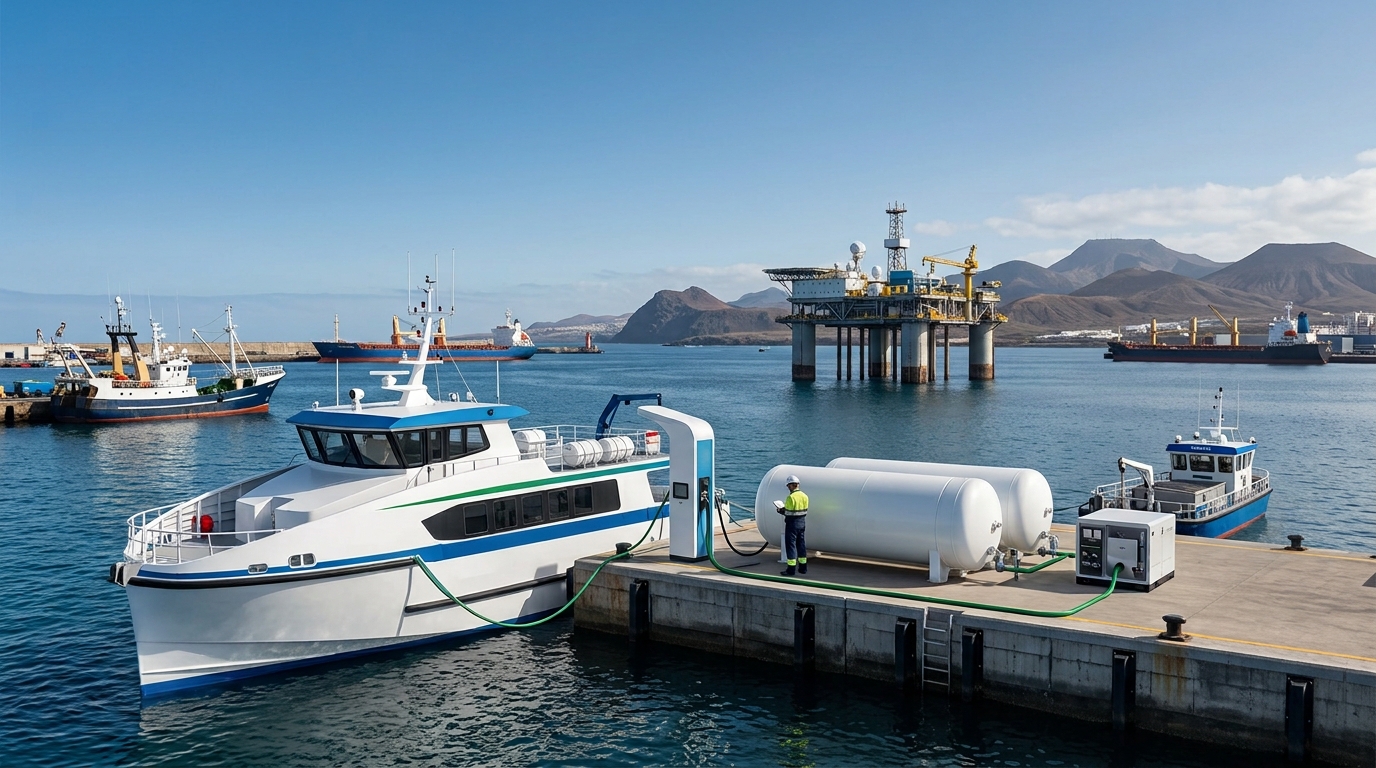
A major European initiative has launched to cut fossil fuel dependence across Atlantic island regions by deploying green hydrogen technologies in local fisheries, port operations, and aquaculture.
The three-year, €7-million project, known as H2BLUE, officially got under way on 1 September and brings together a international consortium of research institutes, industrial partners, and public authorities across Spain, Portugal, and Bulgaria.
Funded in large part by the European Union’s Interregional Innovation Investments (I3) Instrument, the project will use the Canary Islands and the Azores as real-world proving grounds. Work will focus on installing pilot hydrogen refuelling stations, integrating fuel-cell systems into maritime vessels, and evaluating green ammonia production pathways designed to withstand harsh oceanic conditions.
Consulta Europa is taking a leading role in the consortium, heading all communication, dissemination, and exploitation strategies to ensure the project’s findings reach key industry stakeholders, policymakers, and local communities. The team is also working directly alongside project coordinator PLOCAN (the Oceanic Platform of the Canary Islands) to support day-to-day management and regional coordination.
“Transitioning island economies away from fossil fuels requires solutions that are both technically robust and economically viable on the ground,” said Víctor Ricardo Martinez, Operations Director at Consulta Europa. “Our focus is ensuring that the innovations tested during H2BLUE don’t remain isolated pilots, but instead translate into scalable business models, clear policy guidelines, and long-term economic benefits for coastal regions.”
A core pillar of the initiative is a €2-million cascade funding scheme (Financial Support to Third Parties) aimed at accelerating market uptake. The project will open competitive calls offering direct grants to up to 50 European small and medium-sized enterprises (SMEs)—with at least half the funding earmarked for businesses in outermost, transition, or less-developed regions.
Selected SMEs will be able to apply for grants of up to €60,000 to integrate complementary hydrogen technologies, or up to €20,000 to validate and replicate hydrogen-based solutions in real maritime operations.
Alongside Consulta Europa and PLOCAN, key partners include the Spanish National Hydrogen Centre (CNH2)—which is developing specialised hydrogen fuel-cell systems for offshore aquaculture vessels—as well as regional governmental bodies, universities, and private sector leaders across the blue economy.
H2BLUE will run through August 2029. Further details regarding the upcoming SME open calls and pilot demonstrations will be published via official project channels in the coming months.